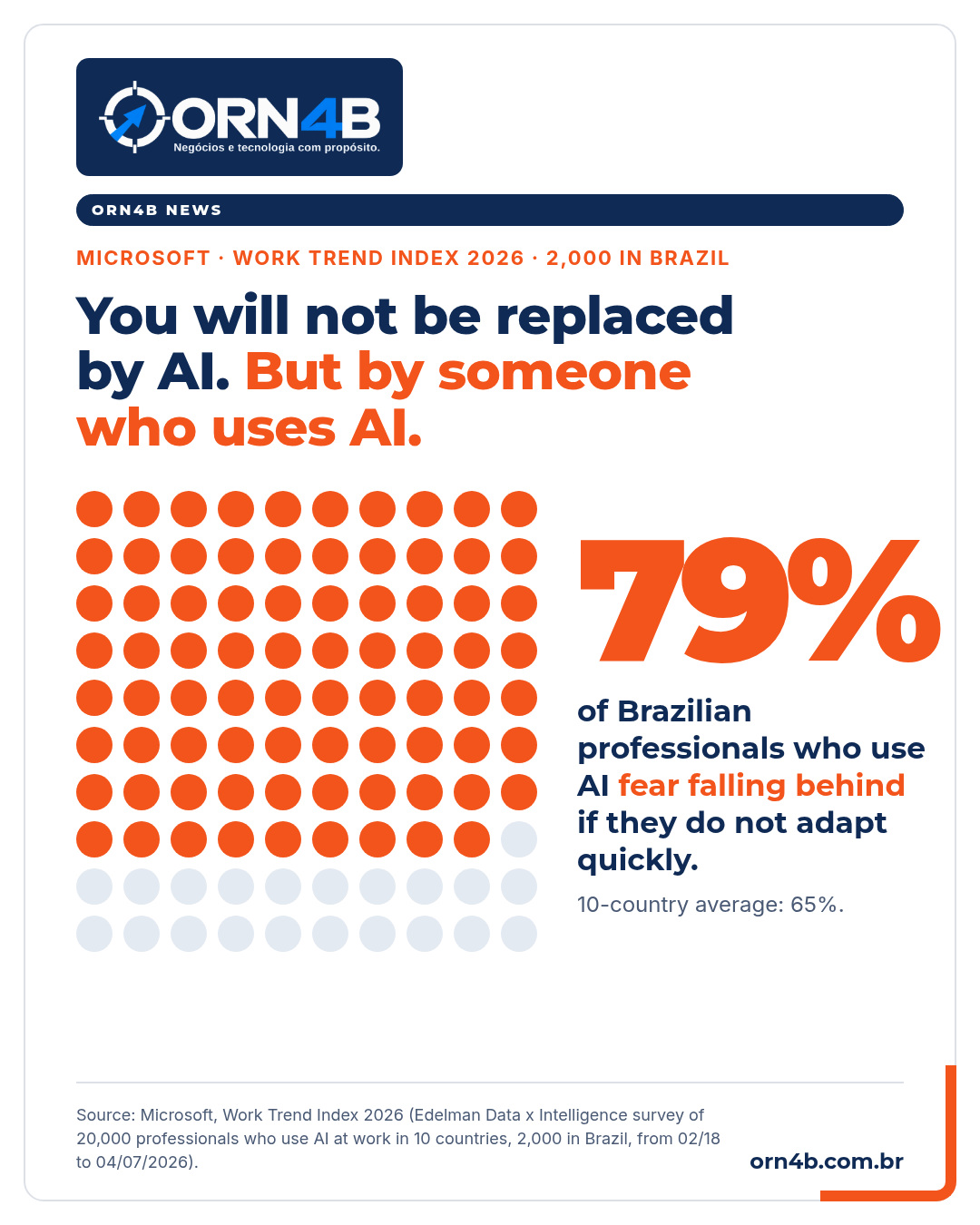
79% of Brazilian professionals who use AI at work fear falling behind if they do not adapt quickly with the technology. Across the 10 countries surveyed, the average is 65%. The figures come from the Work Trend Index 2026, Microsoft's annual report (original report, PDF, p. 26; Microsoft Source LATAM, 05/05/2026; ABES, 05/14/2026; Olhar Digital, 05/11/2026).
Who was surveyed: 20,000 knowledge workers who use AI at work, 2,000 in each of 10 markets (Australia, Brazil, France, Germany, India, Italy, Japan, the Netherlands, the United Kingdom, and the United States). The survey was run online by Edelman Data x Intelligence from 02/18 to 04/07/2026. Note: the sample covers only people who already use AI, so the numbers do not apply to all workers (report, methodology).
What the president of Microsoft Brasil said
On the É Negócio program, a CNN Brasil and NeoFeed partnership aired on 10/26/2026, Priscyla Laham, president of Microsoft Brasil, spoke with journalist Carlos Sambrana about the anxiety AI brings to the labor market:
"we will not be replaced by AI, we will be replaced by someone who uses AI to expand their capacity, including company CEOs." (video, 12min37s: https://www.youtube.com/watch?v=IlLOgtRg1lQ&t=757s; the line also appears in the CNN Brasil teaser, 10/23/2026: https://www.cnnbrasil.com.br/economia/money/negocios/avanco-da-ia-exige-preparo-para-novas-funcoes-diz-especialista/)
She recalled that, according to the World Economic Forum, more roles appear than disappear: "But for that you have to train, upskill the population" (video, 10min17s). And she added: "A large part of the artificial intelligence challenge is in human adaptation, right?" (video, 6min45s).
What the survey shows
Brazil compared with the 10-country average (report, p. 26 and country tables; Microsoft Source LATAM; Olhar Digital; ABES; Veja):
72% of Brazilians who use AI say they produce work today they could not do a year ago (average: 58%);
79% fear falling behind if they do not adapt quickly (average: 65%);
40% feel safer keeping the focus on current goals than redesigning work with AI (average: 45%);
only 16% say they are rewarded for reinventing work with AI (average: 13%).
The figure that matters most for leaders: according to the report, organizational factors such as culture, leadership support, and talent management practices weigh more than twice as much as individual factors on AI impact (67% versus 32%) (Microsoft Source LATAM; ABES; Olhar Digital).
Other studies point the same way
World Economic Forum, Future of Jobs Report 2025 (more than 1,000 employers representing more than 14 million workers): by 2030, the forecast is 170 million jobs created and 92 million eliminated, a net of 78 million. If the global workforce were a group of 100 people, 59 would need training (report, PDF; Portuguese release, PDF; Conselho Digital).
IBM CEO Study 2026 (2,000 CEOs in 33 countries): 83% of CEOs say AI success depends more on people's adoption than on the technology, but they estimate that only 25% of the workforce uses AI regularly (IBM Newsroom, 05/04/2026; Meio & Mensagem; Forbes Brasil).
In Brazil, training still lags: as we showed in the article AI without training, the MIT Sloan Management Review Brasil and CNEX study for TOTVS, with 583 companies, shows that in 37% of them teams fear they do not know how to use AI tools correctly, and only 7% offer a structured AI training program for all employees (report, PDF, pp. 31 and 32; Forbes Brasil; Mercado & Consumo).
What this reveals (ORN4B reading)
This section is ORN4B's interpretation and not a conclusion of the surveys. Fear of falling behind is high, but fear alone does not become competence. If 79% fear falling behind and only 16% feel rewarded for changing how they work, people get stuck in the middle: they use AI loosely, without method and without support.
That is why the line "you will not be replaced by AI, but by someone who uses AI" is a message for the organization, not only for the individual. Who decides whether the team will learn is the company or the educational institution: with time to train, clear rules, and recognition for those who improve work with AI.
And in companies and educational institutions?
In companies: train by role, with real day-to-day cases, and measure what changed in the work.
In educational institutions: train teachers, managers, and administrative teams, and prepare students for a market that already asks for disciplined AI use.
In both: recognize those who redesign work with AI, not only those who hit targets the old way.
The ORN4B flow
AI alone is not the answer. At ORN4B, we work with a modular flow that each company or educational institution contracts according to its maturity:
Awareness (talk): leadership and teams understand what changes with AI and each person's role.
Training (enablement): practice by role, with security and ethics.
Assessment (diagnosis): who already uses AI, how they use it, and where the gaps are.
Planning (strategy): learning paths, usage rules, and indicators.
Implementation (execution): AI enters the work in stages, with follow-up.
Let's talk
Want to prepare your team to use AI with method? Fill out the ORN4B contact form and we will talk about training for your company or educational institution.
Get the next articles: join the ORN4B distribution list and receive each new piece by email or WhatsApp.
Sources
- Microsoft, 2026 Work Trend Index Annual Report (original report, PDF; n = 20,000 AI users in 10 markets, 2,000 per market, Edelman Data x Intelligence, 02/18 to 04/07/2026; Brazil 79%/40%, 16%, 72%/82%; averages 65%/45%, 13%, 58%; 67% vs 32%)
- Microsoft Source LATAM, "Como as Frontier Firms estão reinventando o modelo operacional na era da IA" (05/05/2026; 79%, 40%, 16%, 72%, 82%, 65%, 45%, 13%, 58%, 67% vs 32%)
- ABES, "Microsoft Work Trend Index: por que o protagonismo humano é o verdadeiro destaque da IA?" (05/14/2026; 79%, 40%, 16%, 72%, 82%, 67% vs 32%)
- Olhar Digital, "Brasil é destaque no uso avançado de IA no trabalho, segundo Microsoft" (05/11/2026; nearly 80% vs 65%, 72% vs 58%, 16% vs 13%, 67% vs 32%)
- Veja, "Brasil supera EUA, Japão e Índia no uso avançado de inteligência artificial, diz Microsoft" (72% vs 58%)
- World Economic Forum, Future of Jobs Report 2025 (original report, PDF; more than 1,000 employers, more than 14 million workers; 170M, 92M, 78M, 59 of every 100)
- World Economic Forum, Future of Jobs Report 2025 Portuguese release (PDF)
- Conselho Digital, "Pesquisa do World Economic Forum aponta que 60% dos empregadores esperam que a digitalização transforme seus negócios até 2030" (170M, 92M, 78M, 59%)
- IBM Newsroom, "IBM Study: CEOs are Reshaping C-suite Roles for the AI Era" (05/04/2026; 2,000 CEOs, 83%, 25%)
- Meio & Mensagem, "Inteligência artificial: adoção no trabalho exige cultura" (83%, 25%)
- Forbes Brasil, "CEOs cobram adoção da IA, mas não lideram pelo exemplo" (25%)
- MIT Sloan Management Review Brasil and CNEX for TOTVS, "Da Adoção à Escala: a maturidade da inteligência artificial nas empresas brasileiras" (original report, PDF, released 10/13/2026; 583 companies; 37% pp. 27 and 31; 7% p. 32)
- Forbes Brasil, coverage of the MIT SMR Brasil and TOTVS study (10/15/2026)
- Mercado & Consumo, coverage of the MIT SMR Brasil and TOTVS study (10/15/2026)
- ORN4B, "IA sem treinamento" / AI without training (10/29/2026)
- CNN Brasil, É Negócio with Priscyla Laham, president of Microsoft Brasil (video, aired 10/26/2026; quotes at 6min45s, 10min17s and 12min37s)
- CNN Brasil, "Avanço da IA exige preparo para novas funções, diz especialista" (10/23/2026)
- O Universo da TV, "CEO da Microsoft Brasil analisa impactos da inteligência artificial no mercado de trabalho no 'É Negócio'"