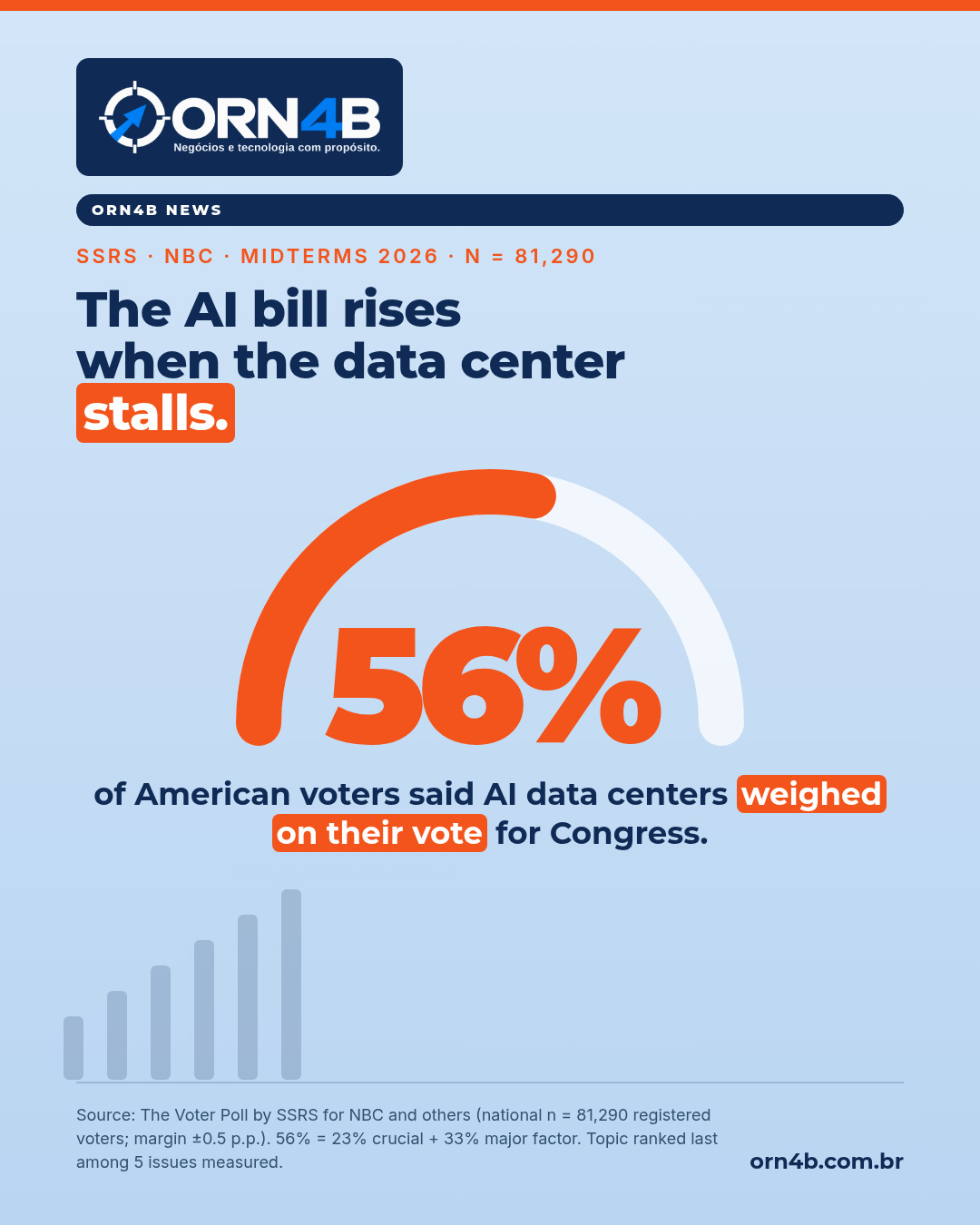
For 56% of American voters surveyed by The Voter Poll by SSRS, artificial intelligence data centers were a crucial or important factor in their choice for Congress. The figure combines 23% who called the topic crucial and 33% who called it a major factor. The national survey reached 81,290 registered voters, with a margin of error of ±0.5 percentage points (SSRS methodology, PDF; Data Center Dynamics; Unite.AI).
Context that cannot be left out: among five topics measured in the same survey (corruption, cost of living, Iran, immigration, and data centers), data centers ranked last. Even so, 76% said they oppose building a new data center in their own community (DCD / NBC).
What local ballots decided
In Ohio, at least 14 cities and districts passed bans or restrictions on data centers (DCD, 11/04/2026). Overall, there were 41 data-center-related measures across 10 states; voters backed restrictions or rejected pro-expansion measures in nearly all of them (CNBC / Ballotpedia).
That does not mean "AI stopped." Projects already licensed and under construction tend to continue. The immediate effect is different: delay, relocation, and the price of compute capacity.
What this changes for companies and schools in Brazil
In Brazil, the Innova Assuntos Públicos survey (via Valor / Times Brasil) mapped 16 state bills on data centers in 2026 (versus 4 in 2025), and 8 of them create restrictions or burdens, focused on water, licensing, and transparency (Times Brasil, 10/13/2026). EPE is already discussing data-center load growth and the electric connection queue (COPAM presentation 09/2025).
What this reveals (ORN4B reading)
This section is ORN4B's interpretation and not a conclusion of the surveys. When compute capacity becomes more contested and more expensive, whoever bought AI without a business objective, without data, and without a metric feels the bill first. It is the same warning as the 11/10 post: AI without an objective becomes a cost. The difference now is that the cost also rises on the infrastructure side.
In practice, that usually shows up like this:
Pilot without an indicator: the company pays for cloud and tokens, but nobody measures what changed in the business or in school management.
Tool before the problem: capacity is bought and then a use case is sought.
No political buffer: the cloud plan assumes stable price and timeline, and local regulation changes both.
The answer is not to stop using AI. It is to prioritize cases with a clear return while capacity stays expensive and contested.
The ORN4B flow
AI alone is not the answer. At ORN4B, we work with a modular flow that each company or educational institution contracts according to its maturity:
Awareness (talk): leadership understands the cost and risk of AI before buying more capacity.
Training (enablement): teams use AI with judgment, security, and metrics.
Assessment (diagnosis): we map where AI is already used, what it costs, and what it delivers today.
Planning (strategy): priorities, budget, governance, and outcome indicators.
Implementation (execution): AI is rolled out in stages, measuring cost and return.
Let's talk
Want to know what AI costs and what it delivers today in your company or educational institution? Fill out the ORN4B contact form and we will talk about where to begin.
Get the next articles: join the ORN4B distribution list and receive each new piece by email or WhatsApp.
Sources
- The Voter Poll by SSRS, methodology (national n = 81,290; margin ±0.5 p.p.)
- Data Center Dynamics, "NBC exit poll: 56%..." (11/04/2026; 23%/33%/56%; 76% oppose a DC in their community)
- Unite.AI, NBC echo + sample >75,000
- Data Center Dynamics, local moratoria (≥14 in Ohio)
- CNBC, 41 measures in 10 states (Ballotpedia)
- Times Brasil / Innova via Valor, 16 bills / 8 restrictive (10/13/2026)
- EPE, Datacenter COPAM 09/2025 (PDF)
- InvestNews (WSJ translation, trigger 11/06/2026)